
Awakening
YEAR: 2026
ORCHESTRATION: 3(II=picc, III=picc,afl).3(III=cor).4(III=bcl, IV=cbcl).3(III=cbn)/4.3.3.1/timp.4perc.hp.cel/3 viols/str
DURATION: 2 hours 30 minutes
LANGUAGE: English
LIBRETTO BY: David Rudkin
SOLOIST(S): Director/Anand: Mark Morouse Prince Gautam, later The Buddha: Cody Quattlebaum
COMMISSIONED BY: Theater Bonn
PREMIERE DATE: March 1, 2026
PREMIERE INFORMATION:
Commissioned by Theater Bonn
Music director: Daniel Johannes Mayr
Stage director: Vasily Barkhatov

Director/Anand: Mark Morouse
Prince Gautam, later The Buddha: Cody Quattlebaum
Kanthak, his horse / The Celestial / An agnostic philosopher Ralf Rachbauer
Messenger of Age / Mara / A Ploughman / An amoralist philosopher Martin Tzonev
Messenger of Sickness / A fiery priest Giorgos Kanaris
Messenger of Death / A Sister Susanne Blattert
Channa / Angulimala / A Warrior King Christopher Jähnig
Lady Gautami, Later Sister Gautami Yannick-Muriel Noah
Princess Yasodhara / Young Mother Katerina von Bennigsen
A Young Actor, Later Sunita / A fatalist philosophe Tae Hwan Yun
An Extreme Asketic / A Vexed Monk Johannes Mertes
A Priest in White Miljan Milovic
A Randomist Philosopher Nicholas Probst
Dancers Natsuki Katori Andras Sousa Davide Degano Jule Niekamp Francesca Merolla
Staging Zinovy Margolin
Costumes Olga Shaishmelashvili
Video Ruth Stofer
Lighting Alexander Sivaev, Jorge Delgadillo
Choreography Sommer Ulrickson
Chorus Director André Kellinghaus
Children and Youth Choir Director Ekaterina Klewitz
Assistant Choreographer Marko Weigert
Assistant Director Lea Theus
Assistant Director and Stage Manager Anna Pies
Stage Design Assistant Antonia Scheffka-Rakitina
Costume Assistant Katja Koch
Music Assistants Caio de Azevedo, Federico Tommaso Fantino
Study Management Igor Horvat
Repetiteurs Jessica Rucinski, Michelle Papenfuss
Stage Management Konstantin Ostheim-Dzerowycz
Surtitles Wolfram Kastorp ,Andreas Schütte, Julia Kluxen-Ayissi
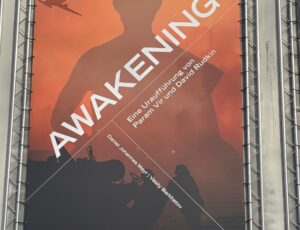

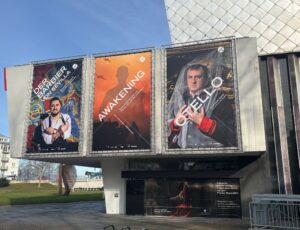
In a country under foreign occupation, the alien régime are eradicating the native language and culture. To preserve what they can, a group of actors memorise the words of their Great Teacher from over 25 centuries ago. In secret venues, this company give ‘underground’ performances of a play they have developed, enshrining the essence of his life-journey and teaching. Our music-drama centres on one such performance. It begins as a player comes forward, in a stylized idiom assumes character as a Prince, Gautam, and tells how, one day as a boy, in the shade of a rose-apple tree, he had a brief glimpse of an enrapturing vision. He almost forgot it: until years later, on his thirtieth birthday, out riding in his father’s park
– Cry of the startled horse, and of Gautam as he falls, rolling onto the acting space. He finds himself in a part of his father’s kingdom new to him. Foul air, foul water… Dirt and dust… Here come to him three troubling Messengers: one bowed with age, one disfigured by disease, one in a deep sleep Gautam cannot recognise. He has been brought up protected from all awareness of aging, sickness, death. Poor little Prince… Dreaming in his father’s garden… These Messengers come to awaken him. Gautam cannot endure the thought: his life till now, a lie, a dream? No. Today is his birthday, today too his young wife has given him a son: he must go home and make ready for the celebration. All must continue, perfect as before.
Masque. At the banquet, the King proudly parades his newborn grandson. Royalty and guests sing in adulation. All present are like masked dummies; dancers, musicians, servants too, all perfect, blemishless. But amid them Prince Gautam begins to writhe as though in a nightmare; suddenly he leaps up in a spasm of revulsion, and the banquet explodes.
Night. At the boundary stone, Gautam comes quietly, to leave his kingdom. The horse (a singing role) is apprehensive:‘Where are we going, Master?’ ‘I go to seek an answer. To a question I had not thought to ask until today.’ He strips off his royal finery, heaps it on the horse. From here he must go on with nothing, and as no one. ‘Master, let me come too and help you!’ Gautam gently but firmly bids him go home to the palace; and, himself mere naked human now, steps out into the dark unknown. The horse laments: ‘My lovely lord is gone. I’ll walk with him no more…’ and sinking beneath the burden of finery, drags himself homeward to die. In a startling interruption, a young actress steps forward from the Company’s play and tells the audience that, at this moment in their previous performance, her brother elsewhere across the city publicly set himself afire as witness to how precious to him his culture and language. The Company observe a silence for him.
As Gautam steps onward into the unknown, he is beset by apparitions of his abandoned family pleading with him to come back. And again the three Messengers confront him, challenging him: what ‘answer’ can he find to age, sickness and death? ‘Answer not to yourselves I seek, but to the sorrow that you bring.’ Last appear priests and philosophers in carnival-like procession, touting their ideologies. Gautam dismisses them: there is no such answer here. Then he sees a fourth ‘Messenger’, very different: a man standing still as a tree, in a shroud-like robe, his only possessions a stick and a bowl. ‘Where was I dreaming, and saw no such man before. Is his some wisdom such as that I seek?’
On the palace terrace, Gautam’s abandoned wife mourns her loss of him; his foster-mother too, who at his birth became as a mother to him when his birth-mother died. They have heard reports of strange sightings of him in the country below – a ‘holy man’, increasingly self-starved, self-lacerated, even sleeping among the dead…
The ‘real’ world cuts into the Company’s performance a second time: a disturbance is heard outside, as in the street a woman immolates herself ‘For my light within!’ The authorities swiftly ‘cancel’ the incident with a happy propaganda song. As the princess and foster-mother resume their scene, Gautam himself appears in a separate reality, six years older and gaunt beyond recognition. In a strange unshared ‘duet’ with them, he tells of his quest – his teachers, his spiritual attainments learned from them, also his own extreme self-severities: but none of them furnish the ‘answer’ that he seeks.
Then the mood changes, to a new stillness and a peace. In sunset light he comes to the bank of a river, and recognises here the place where he must complete his quest himself, and alone. ‘Across the stream there, that pleasing grove… That visionary moment long ago, beneath the rose-apple tree: seek there, strive there, to recapture that…’ The Negative spirit Mara appears to him as a tempter, urging him to be content with what he has achieved. ‘Shine goodness on the world. So harsh your struggle. End your journey here.’ But Gautam is beyond where such temptation can reach. He will cross this river, and in that woodland during the long watches of these coming nights ‘strive in the mind’ until with ‘that eye above the human, I pierce the phantom of this world, and see the knowledge that I seek.’ As he steps into the river, the reality outside the clandestine performance breaks violently in: in a direct bombardment, the venue and the company’s ‘theatre’ are destroyed. But the music reaches on in the upward striving that Gautam has begun; and Act I ends on a mysterious image, a vision of a figure of approaching light.
Act II begins in darkness, with orchestral music of striving toward enlightenment, and enlightenment attained. On a rocky eminence, a solitary figure is experiencing a vision – or rather, re-living a vision he once had, of his own coming-to- be and passing-away in earlier incarnations, and of human souls endlessly dying and reborn, in better or worse estate according to the good or ill they have done in their previous lives. We become aware that this is the Gautam actor, deeply rehearsing his Enlightenment scene. Below around him, survivors of the Company are preparing to resume their performance – improvising costumes and props, rehearsing replacement roles: a mother with a dead child, an outcaste street-cleaner… Their ‘theatre’ here is a bare open space below a jagged wound in the rock where a massive stone image of their Great Teacher has recently been destroyed.
As dawn begins to break, an exodus of refugees come toiling up the mountain road, to escape this afflicted country. The Gautam actor attains to the climax of his vision, a startling existential insight, the roots of the world’s sorrow traced back through a chain of causality to the very birth of each human consciousness itself. But how can he impart this to humanity? What help is it to them? In despair he turns his back on the world. A celestial figure appears, mysteriously pre-glimpsed at the end of Act I, now fully present, urging him turn round, go down among humanity, ‘share with them this wisdom you have found, or the world is lost.’ Gautam, at last persuaded, descends from the rock to begin his mission among suffering mankind. He is becoming recognizable as the ‘Buddha’ now. And without our knowing it, the Company’s play has seamlessly resumed.
In an accumulation of several short scenes, and with severely reduced resources, the Company present iconic fragments from authentic Buddhist tradition. The mother with the dead child, counselled by him to fill her hand with mustard-seeds, one grain from each house she finds where there has been no death; his seemingly magical conversion of a compulsive robber and murderer; his intellectually combative parable of a soldier wounded by a poisoned arrow; his vivid counsel to his own son, now ten years old, on the moral peril of telling a conscious lie; his excoriating Sermon of Fire, where he denounces the human senses and mind as all and each a ‘burning’; his transformative encounter with an ‘untouchable’ outcaste…: underpinning these all, the exposition of the Four Great Truths, and of the Great Eight-Track Path. In this necessarily stark dramaturgy, we are witnessing onstage the creation, 25 centuries ago, not of a religion but of an ethical system free of all theology and myth. But under onslaught of some weapon of pulsing light, this ‘rough theatre’ too is destroyed.
In our final scene, the inner and the outer drama merge. Only two members of the Company live on: the Buddha actor, mortally injured, and the young player we earlier saw given the replacement role of the outcaste street-cleaner Sunita. He helps the older actor struggle onward up the mountain road. Below them, the landscape is all aflame. Within sight of the boundary stone above, the Buddha actor falls dying. ‘Leave me here.’ ‘No, Master!’ ‘That is not the boundary I now cross. My song’s all sung.’ As he dies, silently about them begin to gather ‘the Bretheren and Sisterhood of all the years.’ ‘Sunita’ builds a cairn of stones by the Master’s body. ‘This place shall know for ever that you came this way.’ He looks about him at the scene below. ‘Fire sermon indeed. All my country: a burning. Everything I thought had made me what I am. Now all that dream is burning there. I wake, and I have nothing. No. Not nothing. This play in my head. My body; and my song.’ He starts up toward the boundary stone. ‘On. Up. Out. Away. To be free…’ But as he reaches the summit, in a sudden reversal, all is incandescently transformed…
© Copyright David Rudkin 2015
THE COMPANY
DIRECTOR of the onstage company, later seen as ANAND
A YOUNG ACTRESS making a statement
OLD WOMAN, immolating herself outside
A Young Actor, later seen as SUNITA
A Boy Actor, later seen as RAHUL
The ROAD MANAGER
CHARACTERS IN THEIR PLAY
PRINCE GAUTAM, age 30, later Gautam the Asketic, later yet THE BUDDHA
KANTHAK, his horse
Three Messengers: of AGE; of SICKNESS; of DEATH
CHANNA, the prince’s groom, age about 20
A WARRIOR KING, the prince’s father
LADY GAUTAMI, the prince’s foster-mother
Princess YASODHARA, the prince’s wife, age about 30
Seven PRIESTS and PHILOSOPHERS
MARA, a Negative Spirit
The ‘CELESTIAL’
YOUNG MOTHER with dead baby
A PLOUGHMAN
ANGULIMALA, a crazed bandit
A KING, amazed
RAHUL, The Buddha’s son, age about 10
A VEXED MONK
SUNITA, the outcaste (‘Untouchable’), in his 30s
ANAND, Chief Assistant to the Buddha
A SEEKER FROM OUR WORLD AND TIME
CHORUS
Three girl musicians, Guests, Servants, Villagers, Refugees, Children; Monks and Sisters (on loudspeaker:) A Voice, A Young Woman Singing
The customary term ‘libretto’ seems somewhat slight for a text so dense and weighty as this. It feels to me more a dramatic poem or perhaps more simply a dramaindeed. At its core is a play being presented by an ‘underground’ theatre company in a clandestine venue, in a context of absolutist cultural repression. Their play enshrines, to preserve them, the history and teachings of their culture’s great Founder of 25 centuries before. They begin, in a stylised idiom, with legendary scenes from his early life; then, in a dramaturgy more naturalistic, because here their material is canonical and secure, we see the leading actor rehearse his Great Enlightenment, and growing from that, an accumulation of shorter scenes that dramatise the Teaching itself. This inner company’s theatrical resources – especially of design and lighting – are by necessity minimal. It is I think a moral question: how is our opera house, with its freedoms and much greater resources, to mediate the stark economy of that inner play, without itself being limited by it – yet without losing sight of it.
This inner performance has historical exemplar. In 1940s Nazi-occupied Poland, in the city of Krakow, an underground troupe of actors, the Theatre of Rhapsody, made it their mission to memorise between them the major works of Polish literature, and to give clandestine recitals from these in secret venues while in the streets around them those very books were burning. On one occasion, in a blacked-out upper floor apartment, as a young member of the company (later to become Pope John-Paul II) began to recite the prologue to a Polish national epic, a loudspeaker attached to the wall outside suddenly crackled into life, to announce the latest list of names of citizens arrested and shot.
And so here. Its murderous context will break in upon our inner theatre – not once but again, and again… until, by a theatrical logic we all recognise, it makes away with the inner theatre altogether, leaving the company’s survivors naked to the raging world. So there is much for our outer theatre, with its freedoms and ever-advancing technical resources, to mediate. Often these devices, such as mixed media, are deployed as a mask for the emptiness of the work, or in a specious endeavour to endow it with political ‘resonance’. That’s not necessary here. The relevance is in the fibre and texture of the work itself. If this work shall live to travel into distant futures, theatrical techniques unimaginable to us now will be available, and always appropriate. The abiding issue will persist: how these resources are to be exploited with moral scruple, and taste.
David Rudkin
January 2018