
Awakening
YEAR: 2026
ORCHESTRATION: 3(II=picc, III=picc,afl).3(III=cor).4(III=bcl, IV=cbcl).3(III=cbn)/4.3.3.1/timp.4perc.hp.cel/3 viols/str
DURATION: 2 hours 30 minutes
LANGUAGE: English
LIBRETTO BY: David Rudkin
SOLOIST(S): Director/Anand: Mark Morouse Prince Gautam, later The Buddha: Cody Quattlebaum
COMMISSIONED BY: Theater Bonn
PREMIERE DATE: March 1, 2026
PREMIERE INFORMATION:
Selection of Reviews here
Theater Bonn trailer here
Theater Bonn 'Making Of' video here
Commissioned by Theater Bonn
Music director: Daniel Johannes Mayr
Stage director: Vasily Barkhatov
Director/Anand: Mark Morouse
Prince Gautam, later The Buddha: Cody Quattlebaum
Kanthak, his horse / The Celestial / An agnostic philosopher Ralf Rachbauer
Messenger of Age / Mara / A Ploughman / An amoralist philosopher Martin Tzonev
Messenger of Sickness / A fiery priest Giorgos Kanaris
Messenger of Death / A Sister Susanne Blattert
Channa / Angulimala / A Warrior King Christopher Jähnig
Lady Gautami, Later Sister Gautami Yannick-Muriel Noah
Princess Yasodhara / Young Mother Katerina von Bennigsen
A Young Actor, Later Sunita / A fatalist philosophe Tae Hwan Yun
An Extreme Asketic / A Vexed Monk Johannes Mertes
A Priest in White Miljan Milovic
A Randomist Philosopher Nicholas Probst
Dancers Natsuki Katori Andras Sousa Davide Degano Jule Niekamp Francesca Merolla
Staging Zinovy Margolin
Costumes Olga Shaishmelashvili
Video Ruth Stofer
Lighting Alexander Sivaev, Jorge Delgadillo
Choreography Sommer Ulrickson
Chorus Director André Kellinghaus
Children and Youth Choir Director Ekaterina Klewitz
Assistant Choreographer Marko Weigert
Assistant Director Lea Theus
Assistant Director and Stage Manager Anna Pies
Stage Design Assistant Antonia Scheffka-Rakitina
Costume Assistant Katja Koch
Music Assistants Caio de Azevedo, Federico Tommaso Fantino
Study Management Igor Horvat
Repetiteurs Jessica Rucinski, Michelle Papenfuss
Stage Management Konstantin Ostheim-Dzerowycz
Surtitles Wolfram Kastorp ,Andreas Schütte, Julia Kluxen-Ayissi
INTRODUCTION:
Production photos by Max Borchardt
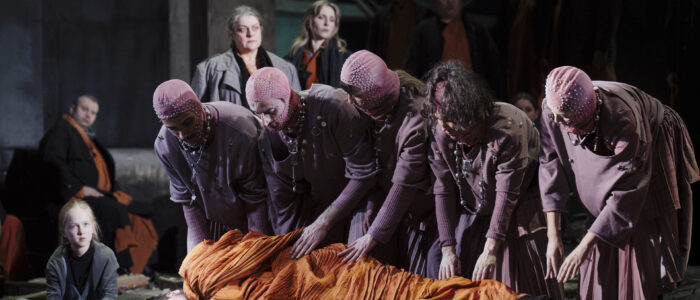
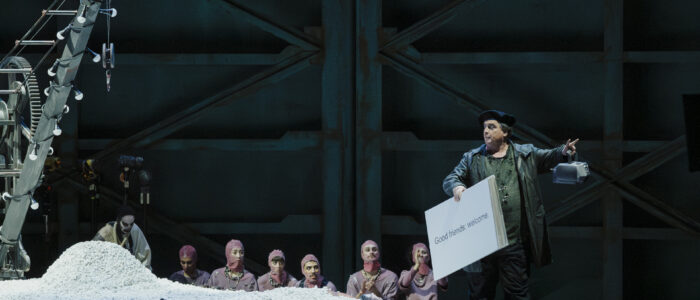
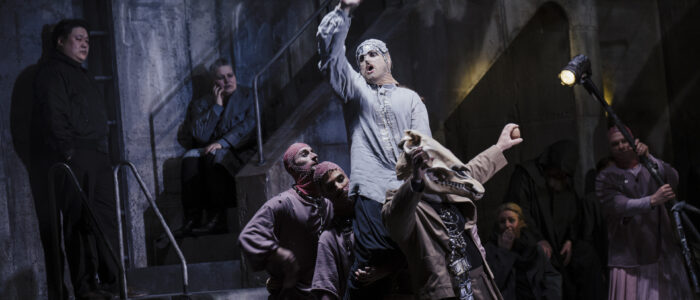
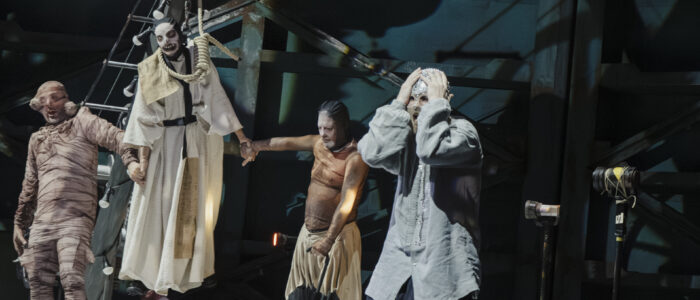
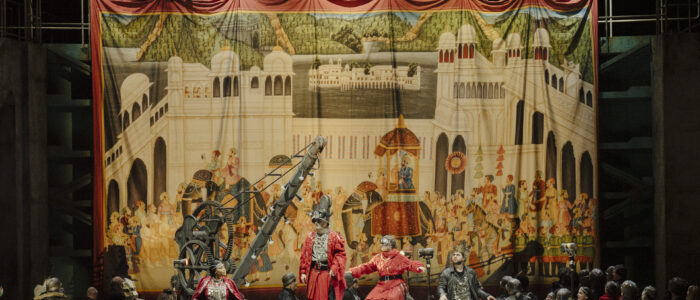
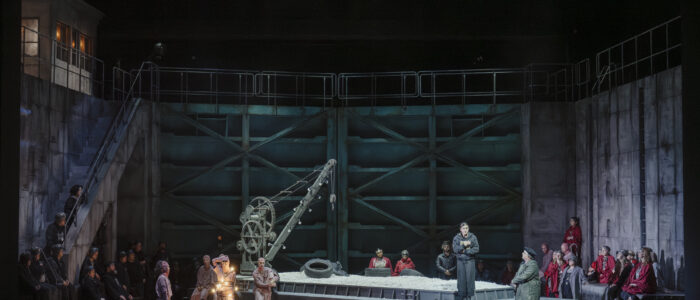
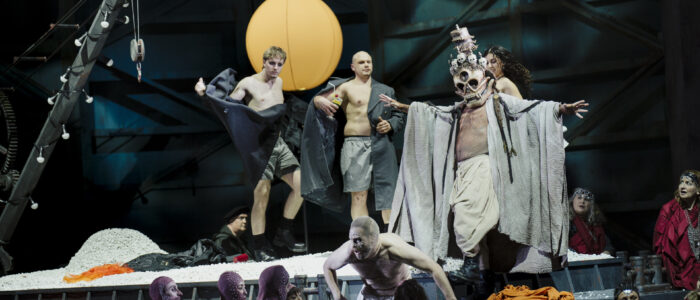
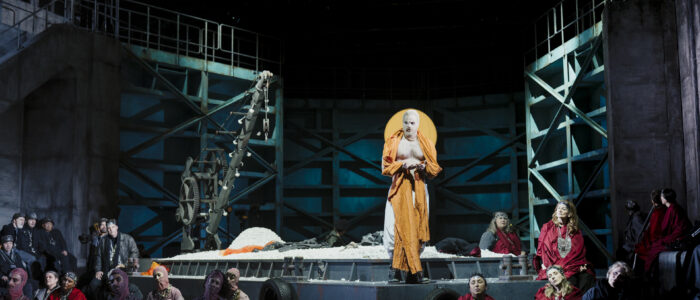
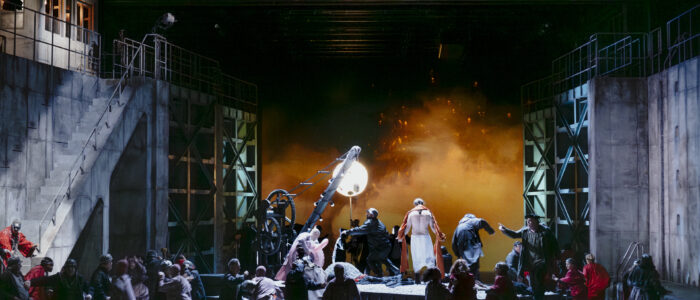
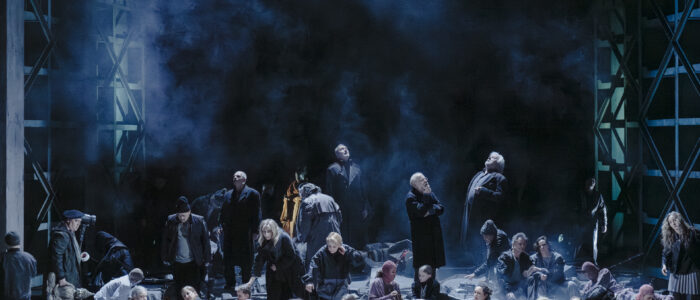
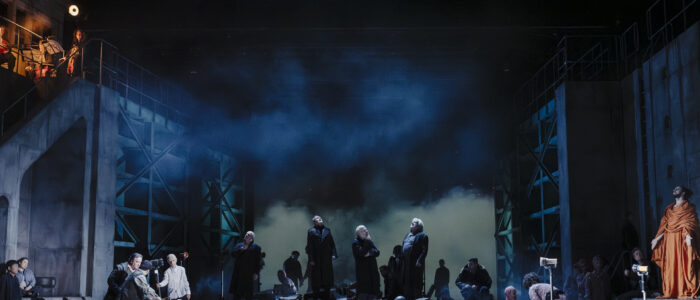
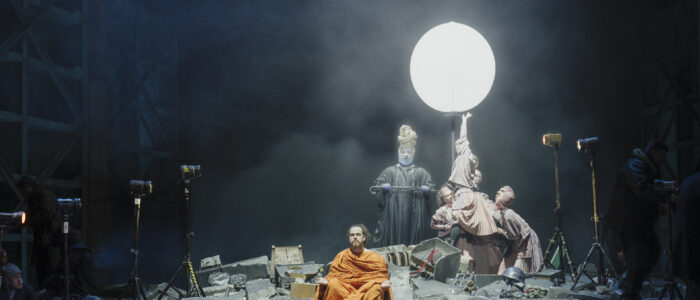
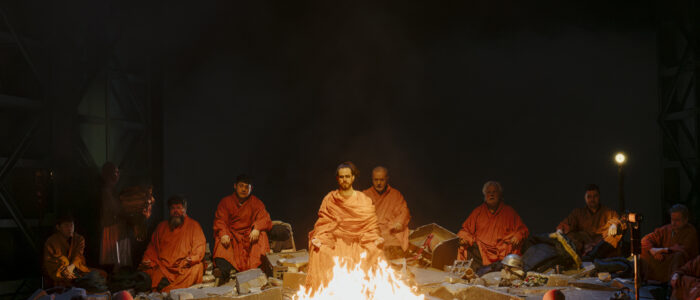

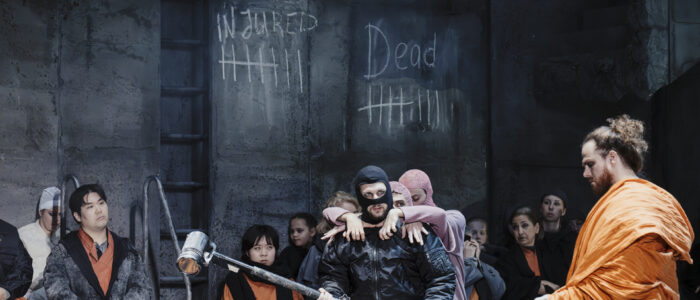
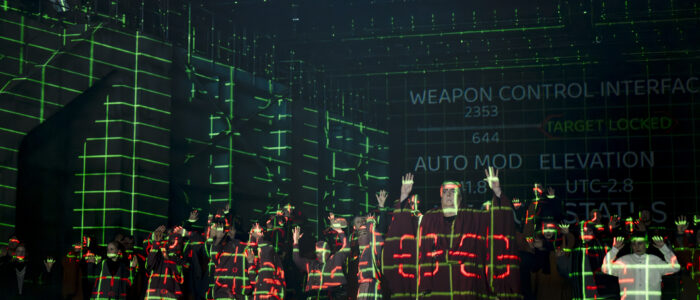
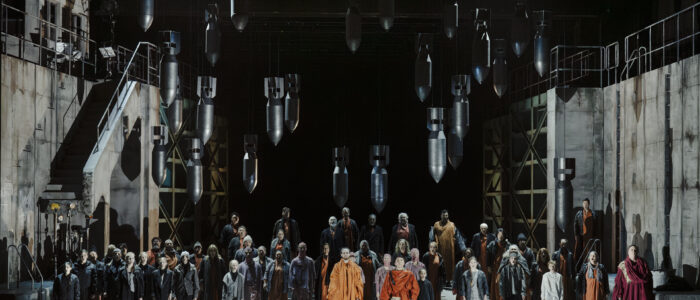
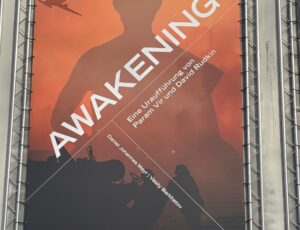
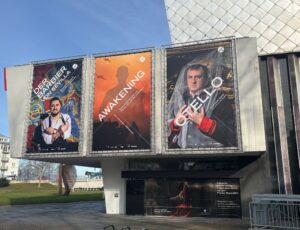
In a country under foreign occupation, the alien régime are eradicating the native language and culture. To preserve what they can, a group of actors memorise the words of their Great Teacher from over 25 centuries ago. In secret venues, this company give ‘underground’ performances of a play they have developed, enshrining the essence of his life-journey and teaching. Our music-drama centres on one such performance. It begins as a player comes forward, in a stylized idiom assumes character as a Prince, Gautam, and tells how, one day as a boy, in the shade of a rose-apple tree, he had a brief glimpse of an enrapturing vision. He almost forgot it: until years later, on his thirtieth birthday, out riding in his father’s park
– Cry of the startled horse, and of Gautam as he falls, rolling onto the acting space. He finds himself in a part of his father’s kingdom new to him. Foul air, foul water… Dirt and dust… Here come to him three troubling Messengers: one bowed with age, one disfigured by disease, one in a deep sleep Gautam cannot recognise. He has been brought up protected from all awareness of aging, sickness, death. Poor little Prince… Dreaming in his father’s garden… These Messengers come to awaken him. Gautam cannot endure the thought: his life till now, a lie, a dream? No. Today is his birthday, today too his young wife has given him a son: he must go home and make ready for the celebration. All must continue, perfect as before.
Masque. At the banquet, the King proudly parades his newborn grandson. Royalty and guests sing in adulation. All present are like masked dummies; dancers, musicians, servants too, all perfect, blemishless. But amid them Prince Gautam begins to writhe as though in a nightmare; suddenly he leaps up in a spasm of revulsion, and the banquet explodes.
Night. At the boundary stone, Gautam comes quietly, to leave his kingdom. The horse (a singing role) is apprehensive:‘Where are we going, Master?’ ‘I go to seek an answer. To a question I had not thought to ask until today.’ He strips off his royal finery, heaps it on the horse. From here he must go on with nothing, and as no one. ‘Master, let me come too and help you!’ Gautam gently but firmly bids him go home to the palace; and, himself mere naked human now, steps out into the dark unknown. The horse laments: ‘My lovely lord is gone. I’ll walk with him no more…’ and sinking beneath the burden of finery, drags himself homeward to die. In a startling interruption, a young actress steps forward from the Company’s play and tells the audience that, at this moment in their previous performance, her brother elsewhere across the city publicly set himself afire as witness to how precious to him his culture and language. The Company observe a silence for him.
As Gautam steps onward into the unknown, he is beset by apparitions of his abandoned family pleading with him to come back. And again the three Messengers confront him, challenging him: what ‘answer’ can he find to age, sickness and death? ‘Answer not to yourselves I seek, but to the sorrow that you bring.’ Last appear priests and philosophers in carnival-like procession, touting their ideologies. Gautam dismisses them: there is no such answer here. Then he sees a fourth ‘Messenger’, very different: a man standing still as a tree, in a shroud-like robe, his only possessions a stick and a bowl. ‘Where was I dreaming, and saw no such man before. Is his some wisdom such as that I seek?’
On the palace terrace, Gautam’s abandoned wife mourns her loss of him; his foster-mother too, who at his birth became as a mother to him when his birth-mother died. They have heard reports of strange sightings of him in the country below – a ‘holy man’, increasingly self-starved, self-lacerated, even sleeping among the dead…
The ‘real’ world cuts into the Company’s performance a second time: a disturbance is heard outside, as in the street a woman immolates herself ‘For my light within!’ The authorities swiftly ‘cancel’ the incident with a happy propaganda song. As the princess and foster-mother resume their scene, Gautam himself appears in a separate reality, six years older and gaunt beyond recognition. In a strange unshared ‘duet’ with them, he tells of his quest – his teachers, his spiritual attainments learned from them, also his own extreme self-severities: but none of them furnish the ‘answer’ that he seeks.
Then the mood changes, to a new stillness and a peace. In sunset light he comes to the bank of a river, and recognises here the place where he must complete his quest himself, and alone. ‘Across the stream there, that pleasing grove… That visionary moment long ago, beneath the rose-apple tree: seek there, strive there, to recapture that…’ The Negative spirit Mara appears to him as a tempter, urging him to be content with what he has achieved. ‘Shine goodness on the world. So harsh your struggle. End your journey here.’ But Gautam is beyond where such temptation can reach. He will cross this river, and in that woodland during the long watches of these coming nights ‘strive in the mind’ until with ‘that eye above the human, I pierce the phantom of this world, and see the knowledge that I seek.’ As he steps into the river, the reality outside the clandestine performance breaks violently in: in a direct bombardment, the venue and the company’s ‘theatre’ are destroyed. But the music reaches on in the upward striving that Gautam has begun; and Act I ends on a mysterious image, a vision of a figure of approaching light.
Act II begins in darkness, with orchestral music of striving toward enlightenment, and enlightenment attained. On a rocky eminence, a solitary figure is experiencing a vision – or rather, re-living a vision he once had, of his own coming-to- be and passing-away in earlier incarnations, and of human souls endlessly dying and reborn, in better or worse estate according to the good or ill they have done in their previous lives. We become aware that this is the Gautam actor, deeply rehearsing his Enlightenment scene. Below around him, survivors of the Company are preparing to resume their performance – improvising costumes and props, rehearsing replacement roles: a mother with a dead child, an outcaste street-cleaner… Their ‘theatre’ here is a bare open space below a jagged wound in the rock where a massive stone image of their Great Teacher has recently been destroyed.
As dawn begins to break, an exodus of refugees come toiling up the mountain road, to escape this afflicted country. The Gautam actor attains to the climax of his vision, a startling existential insight, the roots of the world’s sorrow traced back through a chain of causality to the very birth of each human consciousness itself. But how can he impart this to humanity? What help is it to them? In despair he turns his back on the world. A celestial figure appears, mysteriously pre-glimpsed at the end of Act I, now fully present, urging him turn round, go down among humanity, ‘share with them this wisdom you have found, or the world is lost.’ Gautam, at last persuaded, descends from the rock to begin his mission among suffering mankind. He is becoming recognizable as the ‘Buddha’ now. And without our knowing it, the Company’s play has seamlessly resumed.
In an accumulation of several short scenes, and with severely reduced resources, the Company present iconic fragments from authentic Buddhist tradition. The mother with the dead child, counselled by him to fill her hand with mustard-seeds, one grain from each house she finds where there has been no death; his seemingly magical conversion of a compulsive robber and murderer; his intellectually combative parable of a soldier wounded by a poisoned arrow; his vivid counsel to his own son, now ten years old, on the moral peril of telling a conscious lie; his excoriating Sermon of Fire, where he denounces the human senses and mind as all and each a ‘burning’; his transformative encounter with an ‘untouchable’ outcaste…: underpinning these all, the exposition of the Four Great Truths, and of the Great Eight-Track Path. In this necessarily stark dramaturgy, we are witnessing onstage the creation, 25 centuries ago, not of a religion but of an ethical system free of all theology and myth. But under onslaught of some weapon of pulsing light, this ‘rough theatre’ too is destroyed.
In our final scene, the inner and the outer drama merge. Only two members of the Company live on: the Buddha actor, mortally injured, and the young player we earlier saw given the replacement role of the outcaste street-cleaner Sunita. He helps the older actor struggle onward up the mountain road. Below them, the landscape is all aflame. Within sight of the boundary stone above, the Buddha actor falls dying. ‘Leave me here.’ ‘No, Master!’ ‘That is not the boundary I now cross. My song’s all sung.’ As he dies, silently about them begin to gather ‘the Bretheren and Sisterhood of all the years.’ ‘Sunita’ builds a cairn of stones by the Master’s body. ‘This place shall know for ever that you came this way.’ He looks about him at the scene below. ‘Fire sermon indeed. All my country: a burning. Everything I thought had made me what I am. Now all that dream is burning there. I wake, and I have nothing. No. Not nothing. This play in my head. My body; and my song.’ He starts up toward the boundary stone. ‘On. Up. Out. Away. To be free...’ But as he reaches the summit, in a sudden reversal, all is incandescently transformed…
© Copyright David Rudkin 2015
THE COMPANY
DIRECTOR of the onstage company, later seen as ANAND
A YOUNG ACTRESS making a statement
OLD WOMAN, immolating herself outside
A Young Actor, later seen as SUNITA
A Boy Actor, later seen as RAHUL
The ROAD MANAGER
CHARACTERS IN THEIR PLAY
PRINCE GAUTAM, age 30, later Gautam the Asketic, later yet THE BUDDHA
KANTHAK, his horse
Three Messengers: of AGE; of SICKNESS; of DEATH
CHANNA, the prince’s groom, age about 20
A WARRIOR KING, the prince’s father
LADY GAUTAMI, the prince’s foster-mother
Princess YASODHARA, the prince’s wife, age about 30
Seven PRIESTS and PHILOSOPHERS
MARA, a Negative Spirit
The ‘CELESTIAL’
YOUNG MOTHER with dead baby
A PLOUGHMAN
ANGULIMALA, a crazed bandit
A KING, amazed
RAHUL, The Buddha’s son, age about 10
A VEXED MONK
SUNITA, the outcaste (‘Untouchable’), in his 30s
ANAND, Chief Assistant to the Buddha
A SEEKER FROM OUR WORLD AND TIME
CHORUS
Three girl musicians, Guests, Servants, Villagers, Refugees, Children; Monks and Sisters (on loudspeaker:) A Voice, A Young Woman Singing
The customary term ‘libretto’ seems somewhat slight for a text so dense and weighty as this. It feels to me more a dramatic poem or perhaps more simply a dramaindeed. At its core is a play being presented by an ‘underground’ theatre company in a clandestine venue, in a context of absolutist cultural repression. Their play enshrines, to preserve them, the history and teachings of their culture’s great Founder of 25 centuries before. They begin, in a stylised idiom, with legendary scenes from his early life; then, in a dramaturgy more naturalistic, because here their material is canonical and secure, we see the leading actor rehearse his Great Enlightenment, and growing from that, an accumulation of shorter scenes that dramatise the Teaching itself. This inner company’s theatrical resources – especially of design and lighting – are by necessity minimal. It is I think a moral question: how is our opera house, with its freedoms and much greater resources, to mediate the stark economy of that inner play, without itself being limited by it – yet without losing sight of it.
This inner performance has historical exemplar. In 1940s Nazi-occupied Poland, in the city of Krakow, an underground troupe of actors, the Theatre of Rhapsody, made it their mission to memorise between them the major works of Polish literature, and to give clandestine recitals from these in secret venues while in the streets around them those very books were burning. On one occasion, in a blacked-out upper floor apartment, as a young member of the company (later to become Pope John-Paul II) began to recite the prologue to a Polish national epic, a loudspeaker attached to the wall outside suddenly crackled into life, to announce the latest list of names of citizens arrested and shot.
And so here. Its murderous context will break in upon our inner theatre – not once but again, and again… until, by a theatrical logic we all recognise, it makes away with the inner theatre altogether, leaving the company’s survivors naked to the raging world. So there is much for our outer theatre, with its freedoms and ever-advancing technical resources, to mediate. Often these devices, such as mixed media, are deployed as a mask for the emptiness of the work, or in a specious endeavour to endow it with political ‘resonance’. That’s not necessary here. The relevance is in the fibre and texture of the work itself. If this work shall live to travel into distant futures, theatrical techniques unimaginable to us now will be available, and always appropriate. The abiding issue will persist: how these resources are to be exploited with moral scruple, and taste.
David Rudkin
January 2018
Ricksmusicpicks.de (4 March 2026)
Reviewer: Rick Fulker
The opera AWAKENING, frenetically applauded after its world premiere at the Bonn Opera on March 1, was thirty-two years in the making.
Back in 1994, Param Vir and David Rudkin agreed to collaborate on an opera about the Buddha. The composer and the librettist worked on sixteen versions of the work. Eventually commissioned for the Beethoven year 2020, it was postponed when that became the pandemic year. The production was so elaborate that it couldn’t be squeezed into a season to follow – until now.
Perseverance, patience and impermanence being hallmarks of the Buddhist tradition, the delay didn’t seem to matter much. What are thirty-two years anyway in light of a story that goes back thousands, and with a philosophy where only the present matters?
AWAKENING is a play within a play: Occupied by a foreign power in a wartime setting, interrupted by air raids, an underground theater troupe clings to its forbidden culture by performing a ritualistic play about the ancient teachings of an enlightened one – thus bringing Siddhartha Gautama‘s biography and teachings right into our time.
The timing of the premiere in Bonn was uncanny, if unintentional: missiles, explosions and rubble onstage synchronous with the real thing that had broken out in the Middle East only thirty-six hours before.
British dramatist David Rudkin initially balked at the idea. „When Param Vir first invited me to write an opera about the Buddha, I said, ‚You must be joking because that is the most undramatic subject ever. The most undramatic man, the most undramatic life.‘ But PV has a way of making things happen.“
With the libretto undergoing many changes, what precipitated the final version? It was when Rudkin accessed the primary source of Buddhist teaching, the Pali Canon. „Once I got hold of that, there was an energy that nothing else could give me.“
Of course, it’s not easy to speak of primary sources in what remained an oral tradition until finally being written down 500-700 years after the Buddha’s passing. We now think of the written word as lasting and of the spoken word as unreliable and subject to change and error, but that discounts how human memory works – or once worked. The ancient word-of-mouth tradition finds its parallel in AWAKENING when the theater troupe, whose books have been destroyed, pass along knowledge in spoken presentations.
What began as a labor of love only much later received a commission, says Param Vir. „We wanted somebody who really wanted to do this. And that’s what Theater Bonn did. The opera is full of heart, and the Bonn Opera Director Bernhard Helmich is a heartfelt human being.“
Born in New Delhi and living in London, the composer explained that his musical orientation in the work was Western: „I didn’t want to imitate Indian music. It doesn’t work, can become a pastiche.“
Unlike his partner, Param Vir didn’t find a dearth of drama in the life of the central character. „You can take these simple episodes and turn them into dramatic scenarios. For example, when the Enlightened One is challenged by The Ploughman. Or when the vexed monk throws irrelevant intellectual questions at him, like ‚Is the world finite or infinite?‘ Or when his speaking horse sadly takes his leave.“
Vir explains that he broadly used different compositional idioms for the three phases of the Buddha’s life. „The first was when he was a prince. Here I employed the complete gamut of orchestral and harmonic material. The second is when he became an ascetic in the wilderness, so here I used very simple intervals to mirror the simplicity of the life he’s leading. Finally there’s the enlightened Buddha, where I sometimes established harmonic fields constructed in such a way that they are iconic.“
„But at some point towards the end I didn’t need any strategy,“ adds Vir. „Sometimes I saw composers – Stravinsky, Mozart, Bach – just walking past my window and the music fell on my score! I didn’t copy anything, but it was in my memory. In India we have a tradition where we pay homage to our teachers. And these are the great teachers of the past.“
At the beginning of their collaboration, Param Vir took David Rudkin to India to visit the iconic sites of the Buddha’s life – and repeated the journey in 2019 with Vasily Barkhatov. The Russian stage director, now in heavy demand on Europe’s opera stages, created iconic scenes for the besieged community in a dystopian landscape, like a shipping lock with crane and gravel-filled shovel. The Buddha’s Enlightenment occurs not under a fruit tree but on a pile of rubble.
Over the course of the play, the actors gradually morph into the characters they depict. The play becomes the real thing, or at the very least, the viewer asks himself: What is real, and what is play-acting?
Depicting the central character, bass-baritone Cody Quaddlebaum exudes a stark, singular aura. As does soprano Yannick-Muriel Noah in the role of his stepmother Lady Gautami.
Though not describing himself as a Buddhist, David Rudkin is fascinated by the teachings: „I think they are the best ethical framework. I thought these ideas need communicating.“
Often misunderstood as a feel-good religion, Buddhism is challenging, adds Rudkin. „It’s a very tough proposition because you’ve got to look inside and see where the truth is.“ But what does the philosophy, or this piece, have to say to us now? „You find answers in the so-called eightfold path, which for instance insists on truthfulness in thought. Or truthful livelihood, which means no traffic in weapons, poison or slaves. Well, just think of Jeffrey Epstein.“
At the end, missiles slowly descend on the characters, but are frozen mid-air as though the singing had suspended gravity.
In sounds ranging from delicate to detonation, Daniel Johannes Mayr led the Beethoven Orchestra.
The audience went wild. Standing ovations. Maybe we all needed a bit of truth – or Awakening.
Klassik.com (3 March 2026)
Reviewer: Cristiane Franke
There are coincidences that shouldn't happen, and yet time brings a bitter truth to light. One day after the US and Israeli attack on Iran, the Bonn opera audience witnessed the world premiere of "Awakening." ParamVir, the Indian-British composer, together with the playwright David Rudkin, has transformed nothing less than the life story of Siddhartha Gautama and his most important teachings into a two-act opera with 38 scenes, framed by an unnamed war.
Self-knowledge as a panacea
Director Vasily Barkhatov led the audience through an inferno in two and three-quarter hours with his characteristic precision and relentless psychological depth, an inferno that ultimately gave way to Buddha's core message of overcoming suffering. In the final "Awakening," the spiritual transformation became a goosebump-inducing moment. As the orchestra conjured an apotheotic sound and light magic, the dead rose from rubble, dust, and sound, invoking the end of recurring suffering. Self-knowledge as a panacea? It sounds as simple as it is impossible. Yet, at that moment, it drove the audience to their feet. While some hastily left the venue, others refused to let it end, offering a standing ovation and bravos to the ensemble, the orchestra, and the entire production team.
A Play Within a Play
The process from the initial idea to the completion of "Awakening" took roughly 30 years. The Tibetan conflict played a role, even more so those who set themselves on fire, using this last resort as living torches to draw attention to oppression. Sixteen versions, some extremely different, document the creators' struggle to seriously engage with Siddhartha's inner and outer world in a time of alienation from fundamental beliefs and wisdom teachings. In the end, Param Vir and David Rudkin opted for a play within a play that captivates, even disturbs, from beginning to end, because the transformation of Buddha and the radical insight into the Four Noble Truths, with the goal of overcoming all suffering, actually work in this opera, under the shadow of a brutally staged war.
Existential Experience
This is primarily due to Param Vir's complex musical language. Vir does not subject it to any strict rules. He distills sensations, movements, events, even the unspeakable, into musical notation, utilizing the broad spectrum from classical to avant-garde to equate, comment on, and convey existential and atmospheric experiences with spoken word and orchestral sound. He characterizes this transformation through dissolution, pure intervals, and overtone-rich sonic distillates. Director Vasliy Barkhatov has studied this score with meticulousness bordering on perfection. This is evident in this radically uncompromising production.
Buddha's Teachings as a Way Out of War
ogether with Olga Shaishmelashvili (costumes) and Zinovy Margolin (stage design), he created a grotesque stage set that seems to be in constant motion. The playing area resembles a rubble field in a dry dock, bordered by rusty metal walls with embedded ladders. A cogwheel crane stands amidst blasted-off chunks of stone, hoisting dancers and Death through the air. In this seemingly protected space, a troupe of actors performs the legend of Prince Gautama. Symbolic garments define the demeanor of each protagonist. Puppet theater meets war-scene scenarios. Dancers swirl around, moving in sync with the sounds from the orchestra pit, commenting on or amplifying the symbolic meaning conveyed in words and music.
A wealth of meaning
In the end, one hoped that at least the core of the philosophically elaborated teachings would resonate with the audience, as would much of this meticulously crafted production, which kept them on the edge of their seats with its rich tapestry of meaning. Wherever the eye wandered, interpretation unfolded on multiple levels. It was impossible to decipher everything on a first viewing, especially since the performers, with their commanding stage presence, repeatedly drew everyone's attention.
A magnificent ensemble performance
This was particularly true of the American baritone Cody Quattlebaum, a charismatic Buddha with a powerful timbre. Alongside him, sixteen other soloists, five dancers, and the chorus, children's choir, and youth choir of the Theater Bonn delivered compelling performances. It was a magnificent ensemble effort. Daniel Johannes Mayr conducted the Beethoven Orchestra Bonn with great care, skillfully guiding this gigantic sonic apparatus and ensuring the synchronicity of the music with the flood of images on stage, including all the shocking surprises, all with a keen sense for Param Vir's sonic and chromatic magic.
Commissioned by the Bonn Opera
In recent years, the Bonn Opera has distinguished itself with exceptional productions and projects, including the "FOKUS'33" series. "Awakening" was commissioned by the Bonn Opera, marking another milestone in its commitment to artistically engaging with current political issues—in this case, with unintentionally topical relevance.
Deutsche Bühne (2 March 2026)
Reviewer: Ulrike Kolter
The world premiere of “Awakening” at Theater Bonn demands a great deal from us. The Indian-British composer Param Vir, together with the dramatist David Rudkin, has written an opera about the life path of Siddhartha Gautama and his transformation into the Buddha, framed by a story of war. Director Vasily Barkhatov spares us nothing – and that is a good thing.
Before you read this text, briefly ask yourself: What are your own moral principles? Not to kill? Not to lie? Mindfulness or empathy? Asceticism?
Most of these rules are embedded in Buddhism, which might almost be regarded more as a philosophy of morality than as a world religion. Not the relationship to a creator god, but rather the overcoming of subjective suffering through self-knowledge stands at its center — very much practice-oriented, attainable through the canon of rules known as the “Four Noble Truths.”
Politically Unintentionally Timely
Writing an opera about this teaching and about the life of the historical Buddha, Siddhartha Gautama, is therefore almost an appeal to the audience to engage in self-reflection. And it is a bold undertaking to cast the path of inner enlightenment into an external framework story — especially one shaped by war politics. With “Awakening,” commissioned by the Opera Bonn, the Indian-British composer Param Vir, together with dramatist David Rudkin, has accomplished exactly that — through the artistic device of a play within a play. And it was premiered the day after the attack by the United States and Israel on Iran, lending it a political immediacy that was never desirable.
A Buddhism Opera or a War Opera?
In “Awakening,” originally conceived against the backdrop of the Tibet conflict and today transferable to virtually all additional theaters of war in this mad world, a troupe of actors gathers to retell the transformation of Prince Gautama into the Buddha. Yet, moderated by the theatre director (Mark Morouse), the rehearsals are overtaken by reality: while bombs fall outside, books burn, and the earth trembles, they improvise inside on a stage made of war machinery and rubble, surrounded by towering, rusted metal scaffolding. Their reenactment of the Buddha’s life thus appears as resistance against hatred and oppression. Act I ends, after an attack on the theater, in a conflagration.
Star director Vasily Barkhatov — who most recently staged a fairy-tale Eugene Onegin in Bonn and will direct the new Bayreuth Ring in 2028 — has, together with costume designer Olga Shaishmelashvili and set designer Zinovy Margolin, created a bleak panopticon of masked and thus anonymized figures. They wear balaclavas or skull masks, some adorned with pearls or scarves. The chorus and extras populate the side stage for almost the entire three-hour evening as onlookers, while dancers in pink garments move like shadows. Once again, Barkhatov shows his flair for large ensemble arrangements, having staircases and galleries played upon or lifting figures into the air with a gear-operated crane.
There is much grotesque imagery to grasp alongside the philosophically charged libretto — and alongside Param Vir’s harmonically complex tonality, which under the baton of Daniel Johannes Mayr underscores the numerous parlando scenes and plays with the significance of intervals. Harps shimmer in moments of transcendence, while the strings plunge downward in the dying of bodies. And all the brief didactic maxims and parables, written in clearly understandable everyday English, give the audience much to digest.
Annihilation
The American baritone Cody Quattlebaum portrays Prince Gautama with great intensity and remarkable stamina. After encountering the three figures of Old Age, Illness, and Death in Act I — and thereby understanding human suffering — he leaves family and kingdom: “I need an answer to the agony of our decay.” Transformed into the Buddha — now unmasked after the intermission and dressed in an orange monk’s robe — his performance continues atop a heap of rubble, while a chorus of displaced persons carries away the bodies. The fragmentary scenes and dream sequences of Act II then negotiate the Buddha’s path to enlightenment and that of his followers, leading up to their annihilation — and resurrection.
From the vast ensemble, Tae Hwan Yun (with a radiant tenor as Sunita) and Yannick-Muriel Noah (as Gautama’s sister) stand out in particular. One cannot grasp all the parables with both heart and mind. At times, the shift from abrupt mass executions to stage-wide war photographs and grotesque-dance commentary is difficult to endure. Nevertheless, one listens and follows, spellbound every second, and remains shaken afterward. A transformative evening.